Table of Contents
Photos Link to heading
Papa’s got a brand new keytar.
Overview Link to heading
- https://reverb.com/p/moog-liberation
- https://www.vintagesynth.com/moog/liberation
- https://en.wikipedia.org/wiki/Moog_Liberation
Specification Link to heading
Basics
| Features | Description |
|---|---|
| Architecture | Analog / Subtractive (See below.) |
| Audio | Mono output |
| Control Voltage | Trig + Gate out |
| Form Factor | 44-key synthesizer + performance controls |
| Manufacture Period | 1980-81 |
| Polyphony | Monophonic dual VCO / Divide-down polyphonic OSC / Noise OSC |
Manuals
Thoughts Link to heading
The premise behind the “keytar” is ridiculous, i.e., that the keyboard player can finally get out of their “keyboard fortress” to “strut their stuff” up front on stage.
Though it does not seem possible, these photos actually depict 2 completely different people…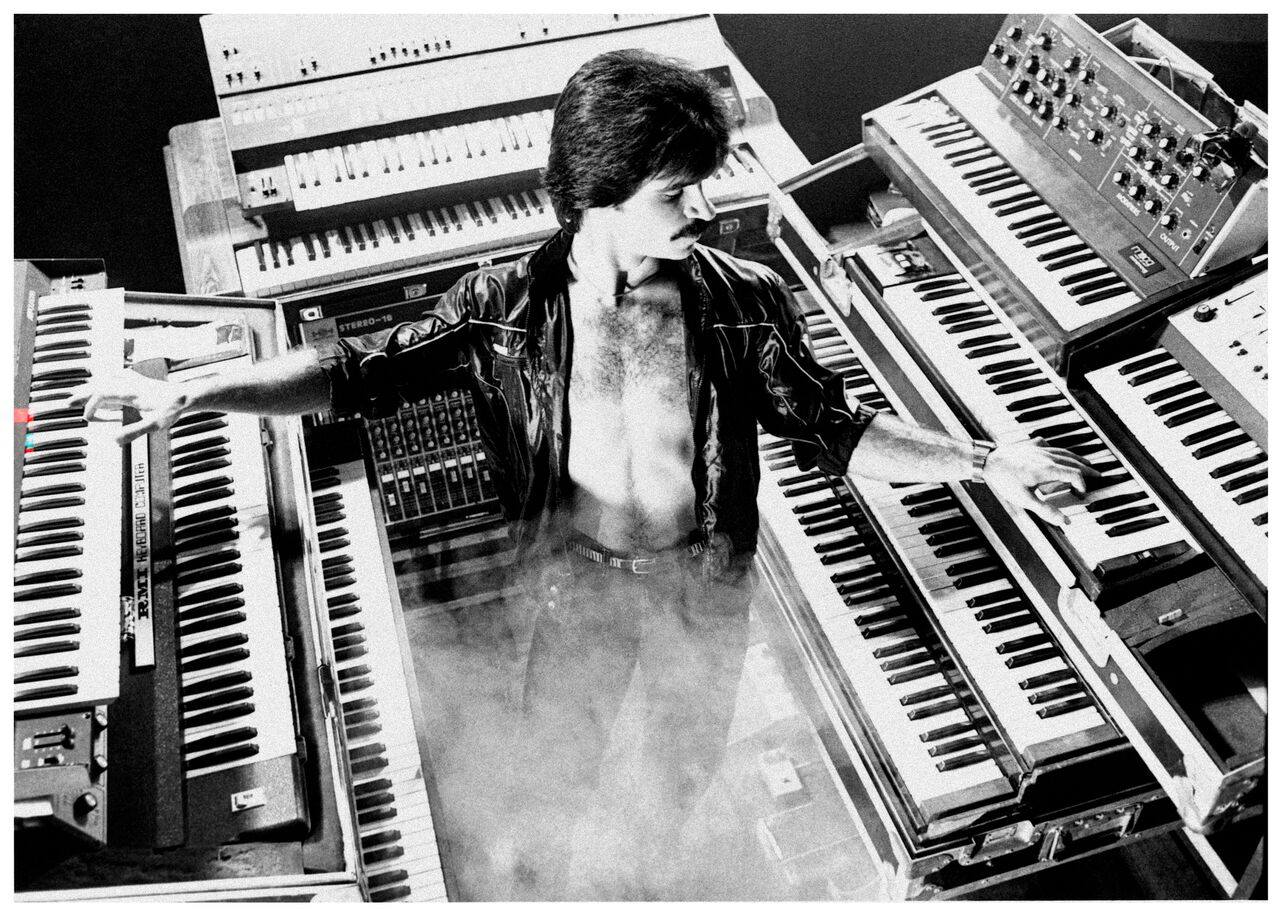
The Yamaha CS-50 / CS-60 / CS-80 series of polysynths are often cited as the most expressive keyboard instruments ever made. Modern attempts to reach this storied level of expression on keyboard instruments like:
- the Osmose keyboard
- modern MPE controllers like:
are really good, but I believe the Moog Liberation deserves to be in this conversation. It’s the most expressive musical keyboard instrument I’ve ever played. It just happens to be a wearable synthesizer.
Moog set out to design an instrument with comprehensive, high-quality performance controls (this intent is clearly stated in the Moog Liberation Owner’s Manual) & they absolutely crushed it in the silliest possible way.
PS. It also sounds great.
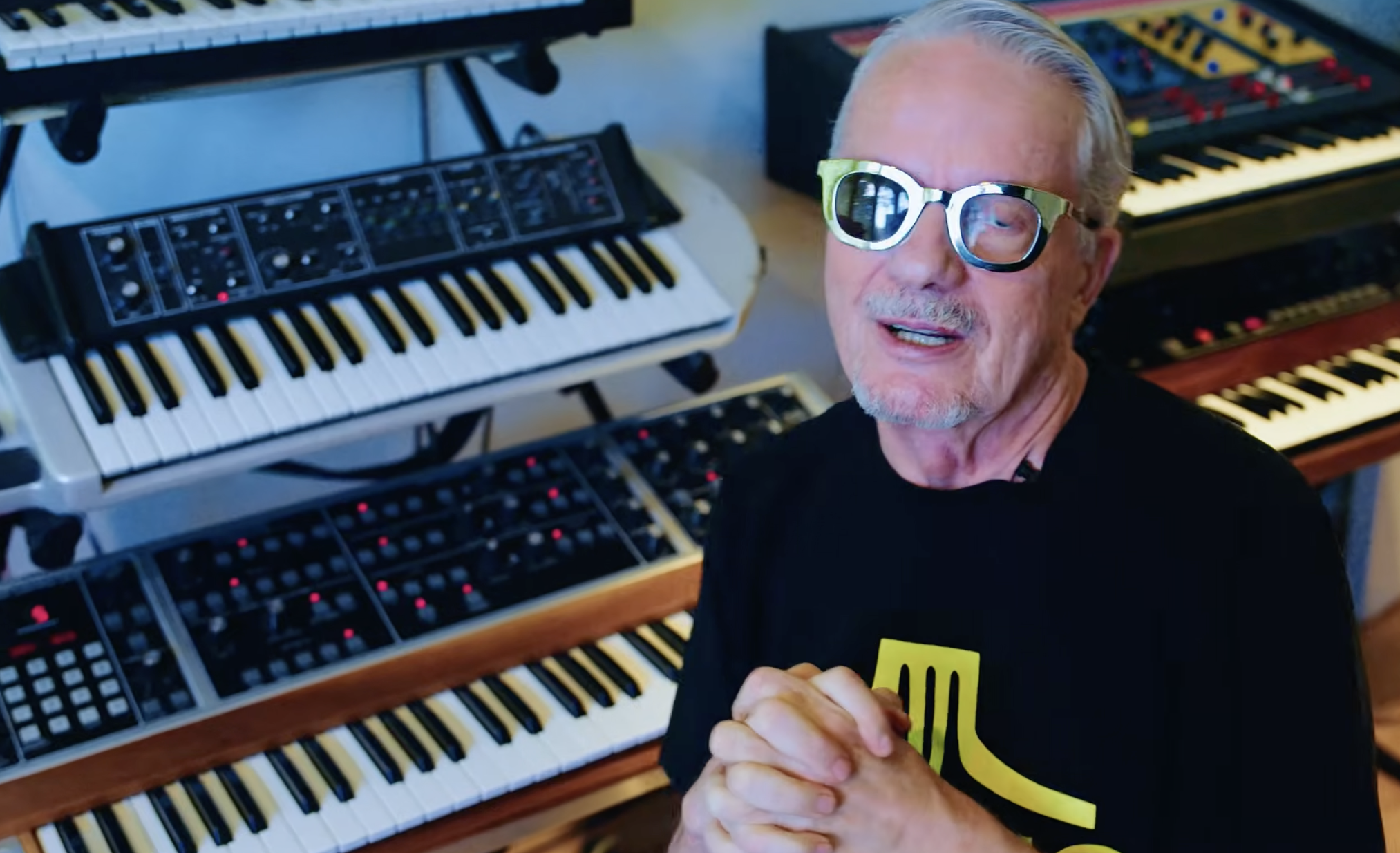
That Moog would use Devo - the weirdest, dorkiest band they could find - in an advertisement for their weird, dorky product, in my opinion, speaks volumes about human creativity. (Here is a picture of Mark Mothersbaugh sitting in front of a Moog Liberation in his studio.)
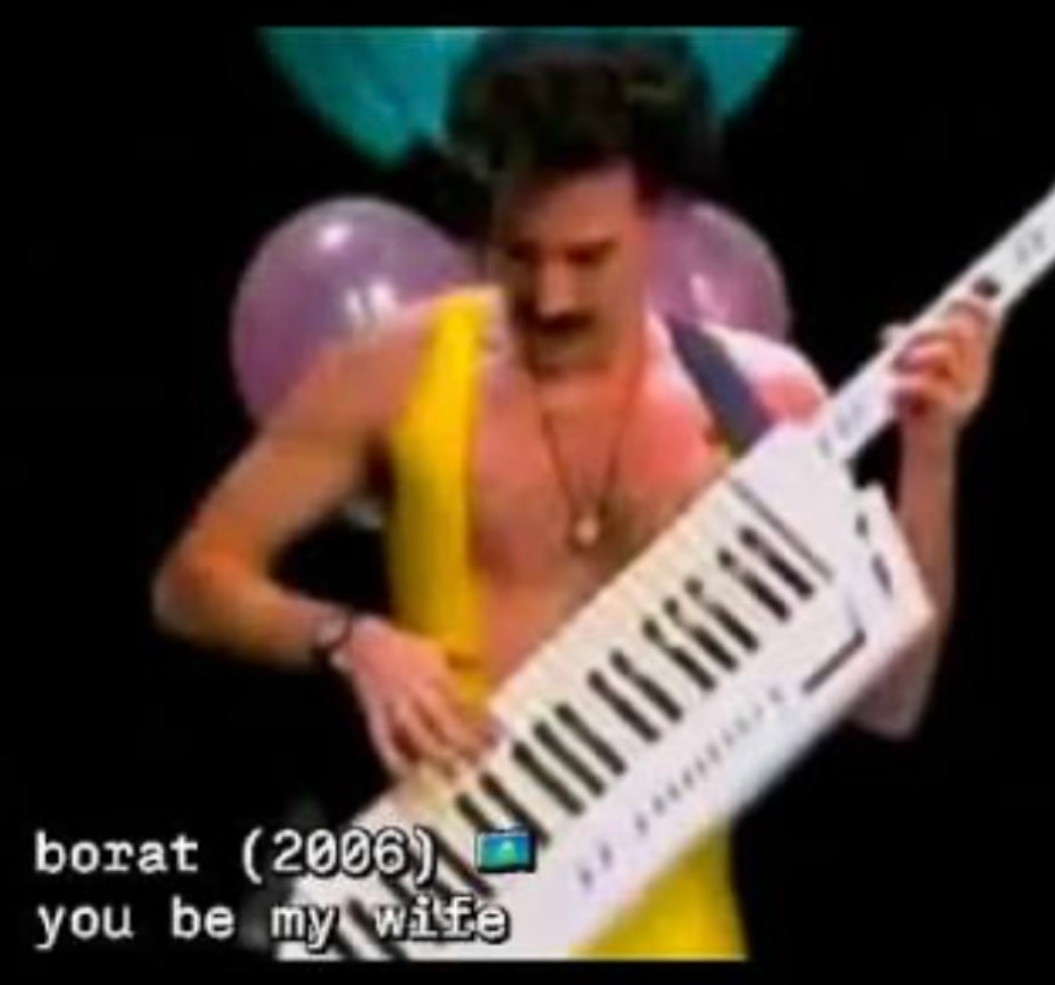
It’s not too late to whip it.
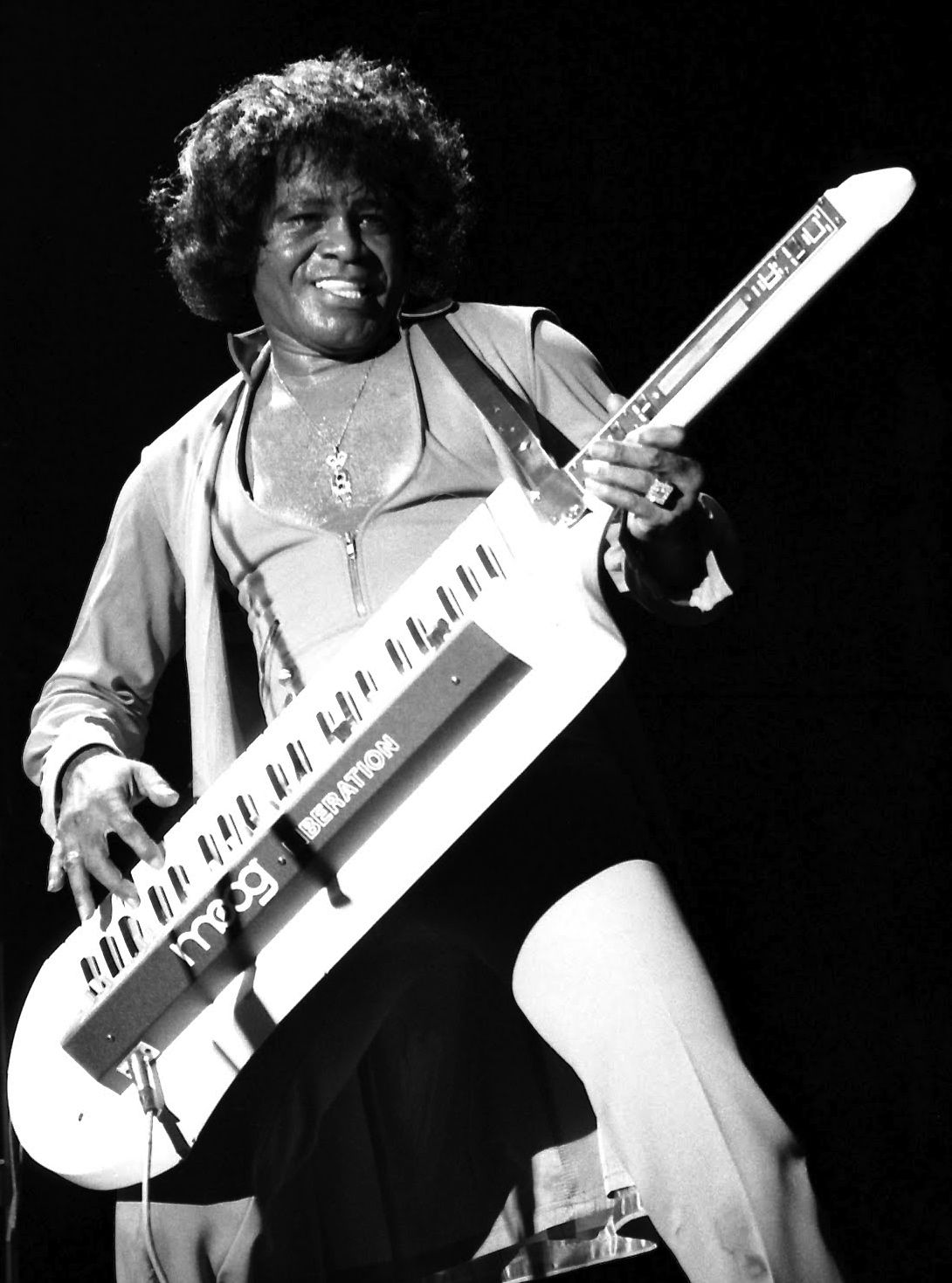
I don’t have any commentary on the James Brown photo other than that it fills me with unspeakable joy. 🌈🦄
I recently sold a Moog Liberation on Reverb.com. Here’s what I put in the listing to describe it:
The Moog Liberation (because it is a “keytar”) is probably the most criminally underrated synthesizer in the history of the Moog brand.
Features:
- 44-note key bed with aftertouch
- 3 oscillators + a noise source:
- 2 basically identical oscillators with triangle, sawtooth or square wave shape
- the duty cycle of the square waves differs on osc 1 vs. osc 2
- oscillator 2 can be detuned from oscillator 1
- oscillator 2 can be hard-synced to oscillator 1
- sync amount can be controlled by mod sources
- the 3rd oscillator is a divide-down square-ish tone that‘s fully polyphonic
- it has its own mixer channel
- it can be modulated with the VCF & VCA
- 2 basically identical oscillators with triangle, sawtooth or square wave shape
- the keyboard is fixed top-note priority
- osc 1 & osc 2 stack as the top note of any chord you play
- a ring mod channel for cross-modulation of osc 1 against osc 2
- the VCF is a classic Moog ladder filter
- exactly what’s in other Moog synths from the same era
- Rogue, Polymoog, Multimoog, Micromoog, Source, etc.
- powerful & squelchy with all 3 oscillators driving it
- exactly what’s in other Moog synths from the same era
- The LFO has 3 shapes: triangle, square, sample & hold
- LFO can be routed to oscillator pitch via aftertouch or modulation wheel
- LFO can be routed to the filter via aftertouch or modulation wheel
- or, pretty much any combination of those you want
- a dedicated envelope for the filter
- a dedicated envelope for the amp
- performance controls on the neck:
- fixed wheel for volume
- spring loaded wheel for filter cutoff
- fixed wheel for modulation amount
- ribbon for pitch bend with middle detent for bends up or down
- on / off switch for portamento
- fixed wheel for aftertouch amount
- switch for routing aftertouch to modulation or pitch bend
You can make fun of keytars. You really can’t make fun of the Moog Liberation as a synthesizer.
Story Link to heading
Wind Up Link to heading
When I was around 11 or 12, I was involved in music through school band (saxophone & bass clarinet), the school district choir (which you joined via nomination from your school’s music teacher) & singing in the Metropolitan Boys choir.
But what I really wanted to do was play the piano.
My sister was majoring in some kind of music therapy program for a while, so there was a rented piano in the house. I used to play along with the music from TV commercials on the piano (which kind of made everyone curious about how I did that).
I always believed my mom was a frustrated pianist. The story she told was that, when she was young, my grandparents (her parents) owned a piano. It was in the living room. One day, my grandpa (her dad) spontaneously replaced the piano with a console TV / radio / record player. She never really forgave him for this.
As an adult, my mom worked in downtown St. Louis as a “steno” girl. She scribbled notes in shorthand everywhere her whole life. She also typed 120 words a minute from dictation, which prevented me from having to learn how to type until well after I moved away from home for college.
In addition to these impressive skills, she had an exhaustive knowledge of melodies & lyrics for just about every song written before 1965. She claimed this was from spending her lunch breaks listening to records in the demo booth at the “record store”, which was a thing you could do. A “record store” was a store where recorded music was sold. Record stores today only exist as phantasms of what they were.
My mom & dad both loved music. I hardly remember a time growing up when there was not some kind of music playing in the house.
I still had to beg them for piano lessons.
Eventually, my mom signed me up with the neighborhood piano lady, Marilyn Deichert. The piano studio was in the Deichert home. They lived in Golden Valley, about 10 minutes from us. At lesson time, per usual, mom was the chauffeur.
The Deicherts had 2 baby grand pianos nestled back to back in their living room. See, Mrs. Deichert was married to Mr. Deichert (Bob), one of the most beloved pianists in the Twin Cities. He wore a pristine white tuxedo while playing a sparkling white grand piano for many years at the Dayton’s Sky Room in downtown Minneapolis. (This topic is probably worthy of an entire post by itself.)
Mrs. Deichert was a fine pianist & a kind person. I am grateful to her for improving my music reading skills by making me fill out ledger line workbooks. (I was not very grateful for this at the time.) She introduced me to beginner-level classical repertoire & technique, which I needed. I am sure countless students benefited from her methods. I can’t say she was the most inspirational teacher I ever had.
She did not like that I played things by ear more than by reading notes, but she understood this is where I was headed. I probably would have been better off with a teacher willing to battle with me…
forcing me to rigorously play scales & intermediate-level classical music. Instead, she tried to appease me by suggesting that I play arrangements of TV show theme songs & the Music Box Dancer.
So, after just about 3 years, I quit the lessons. But, we still had the piano at home so I tinkered.
Pitch Link to heading
Later, in 8th grade, Dave King, who I knew from band class, walked up to me in the hallway one day & matter-of-factly said “I hear you play keyboards. You & me are going to be in a rock band.”
I needed a keyboard to play in a rock band. I convinced my dad to get me one. We settled on the brown Yamaha DX9. I played it through a giant, brown 200-watt Yamaha bass amp with a 15" speaker (that I wish I still had). I had no idea how hobbled the DX9 was compared to its much more famous cousin, the Yamaha DX7, but it didn’t really matter that much for playing rock covers in Dave’s basement.
Eventually, we got a new bass player / singer, Reid Anderson. Dave & Reid are still playing music together after all these years.
There was another hot band on the junior high scene. I was friendly with a few of the members from playing soccer with them. The guitar player was Todd Haug & the keyboard player was Craig Taborn.
All of these people grew up in the same town as me, within a short bike ride from my house. (Maybe it was the Wheaties™.)
I was completely in awe of Craig. He was (is) much, much better at playing keyboards than I am. One of the keyboards he played was a Moog Liberation.
I once saw this band do a cover of “Purple Haze” with Craig singing. In my memory (possibly faulty) he was rocking the Moog Liberation during the performance. Occasionally, I would hang around while this band practiced. When they launched into “Tom Sawyer” by Rush, Craig would casually do a perfect emulation of the famous opening filter sweep on the Liberation. After seeing him use it, I decided that whatever the Moog Liberation was or was not, I had to have one.
I don’t know if Craig remembers it, but he & I both went to see a Spyro Gyra mid-80’s Minneapolis tour stop at the Guthrie Theater back when it was still part of the Walker Art Center complex.
That version of the Guthrie & its re-creation at the new Guthrie complex in the old mill district of Minneapolis was / is a “theater-in-the-round”. The room, designed as a playhouse, was / is an excellent music venue. I went so many times with my family & friends (to see ‘A Christmas Carol’, comedy performances, concerts, etc.) I can barely remember all of it.
When I was young & impressionable I was particularly struck by Spyro Gyra’s live album ‘Access All Areas’ & fellow Moog Liberation owner / keyboard wizard Tom Schuman whose playing I still admire. This version of the band included legendary Weather Report percussionist Manolo Badrena & mallet virtuoso Dave Samuels. I fully admit to almost always fast-forwarding through the “meh” saxophone playing to get to the “good parts”.
Some jazzy Multimoog: very similar to the Liberation.
Some of Spyro Gyra’s music is turgid & corny. It’s the kind of music that was played in between commercials, during weather updates or while golf tournament scores were being shown on TV. But, it was somewhat innovative when it arrived in the early 70’s & it was popular as instrumental music at a time when music with singing & lyrics dominated the culture. It’s Latin-tinged, “Yacht Rock”-ish, executed well &, most importantly to me, it featured synthesizers & electric piano.
On these mid-to-late 80’s tours, Tom Schuman was definitely surrounded by a “keyboard fortress” & used his “Liberation” to “strut his stuff” out front on stage. The video at the bottom of this post featuring him pretty much sums up the wonderful goofiness of the “keytar” in its prime…
Home Run Link to heading
Learning how to use the DX9 in Dave’s basement was the genesis of my lifelong gear obsession. Acquiring the Moog Liberation shortly thereafter was the point of no return.
In 1985-ish, I found a listing in the back of Keyboard Magazine for a Moog Liberation with an included road case at Rogue Music in New Haven, CT for $475. I still have it!
My Liberation was modded by a crazy synthesizer technician in Prescott, AZ in the late 1990s with a tiny 3-way toggle switch that sets the range of both oscillators up or down 1 octave. This gets it very close to Minimoog bass territory, which an un-modded Liberation can’t do. The toggle switch mod can be seen in the first photo in the thumbnail set at the top of the article along with the alternative miniaturized power supply I use that makes the keyboard a lot more portable. I keep the original Moog 19" rack power supply permanently mounted in my studio rack. Everything was serviced in 2019 by Chris at “This Old Synth” in San Jose, CA. It works perfectly & sounds amazing.
The 3rd photo in the thumbnail set is the Moog Liberation I sold on Reverb.com. It did not work when I bought it & the synthesizer control section was literally hanging by the wires. I intended to harvest parts from it for my original Liberation if needed. The guy in Prescott got it working. The guy in San Jose insisted on fully restoring it, which I did not ask for. (Life lesson: good technicians are so rare & so weird, basically, they must be indulged & deferred to…)
What does it sound like? Link to heading
Who played it? Link to heading
Tom Schuman (Spyro Gyra) Moog Cookbook Brandon Coleman Jean Michel Jarre Tom Coster