Table of Contents
Photos Link to heading
Overview Link to heading
There isn’t a lot on the inT0Rw36z about Cordovox (nor do I expect there to be). Information that exists (unless I am missing it elsewhere) lives in Reverb & eBay sale listings or very old forum posts, so, I am thankful for the history below. It seems to be “comprehensive” even if it’s not actually “brief”.
My article? Also not brief.
Specification Link to heading
Basics
| Features | Description |
|---|---|
| Audio | Mono Input |
| Electrical / Power | On / Off, Fast / Slow Switching |
| Form Factor | 8" Passive Speaker Cabinet w/ Motorized Rotating Drum |
Manuals
Manuals exist for Cordovox units but I have yet to find one specifically for the CL-10.
Thoughts Link to heading
Old Folks Link to heading
There is a saying:
“The more things change, the more they stay the same.”
This is mostly wrong.
True dat.
For example, there was a time when accordion music was popular. I don’t mean some people liked it. I mean, it was on TV FOR YEARS.
Before there were accordion-focused TV shows, there were millions of records sold & dancing & parties & all sorts of stuff related to Polka & Schottische & whatever else made by musicians that most people now do not remember. Someone I remember seeing on TV when I was a kid was “America’s Polka King”, Frankie Yankovic. A comparison to what passes for culture today: imagine a TikTok influencer with many, many millions of followers, but, instead of putting on makeup or making stupid jokes, they played accordion in the videos…
How does one make sense of cultural shifts now or in the past?
One explanation for the past popularity of accordion music in the USA arises from an understanding of German immigration to the Americas starting in the 17th century. People with German 🇩🇪 ancestry make up close to 15% of the US population today. This massive shift of people from one part of the world to another is considered by many demographers & social scientists to be one of the most successful mass migrations in history. Lots of these folks brought their accordions (& their beer recipes) with them on the journey…

The author in Munich with a cartoon-sized Dunkel across the street from Hofbräuhaus (pictured below).
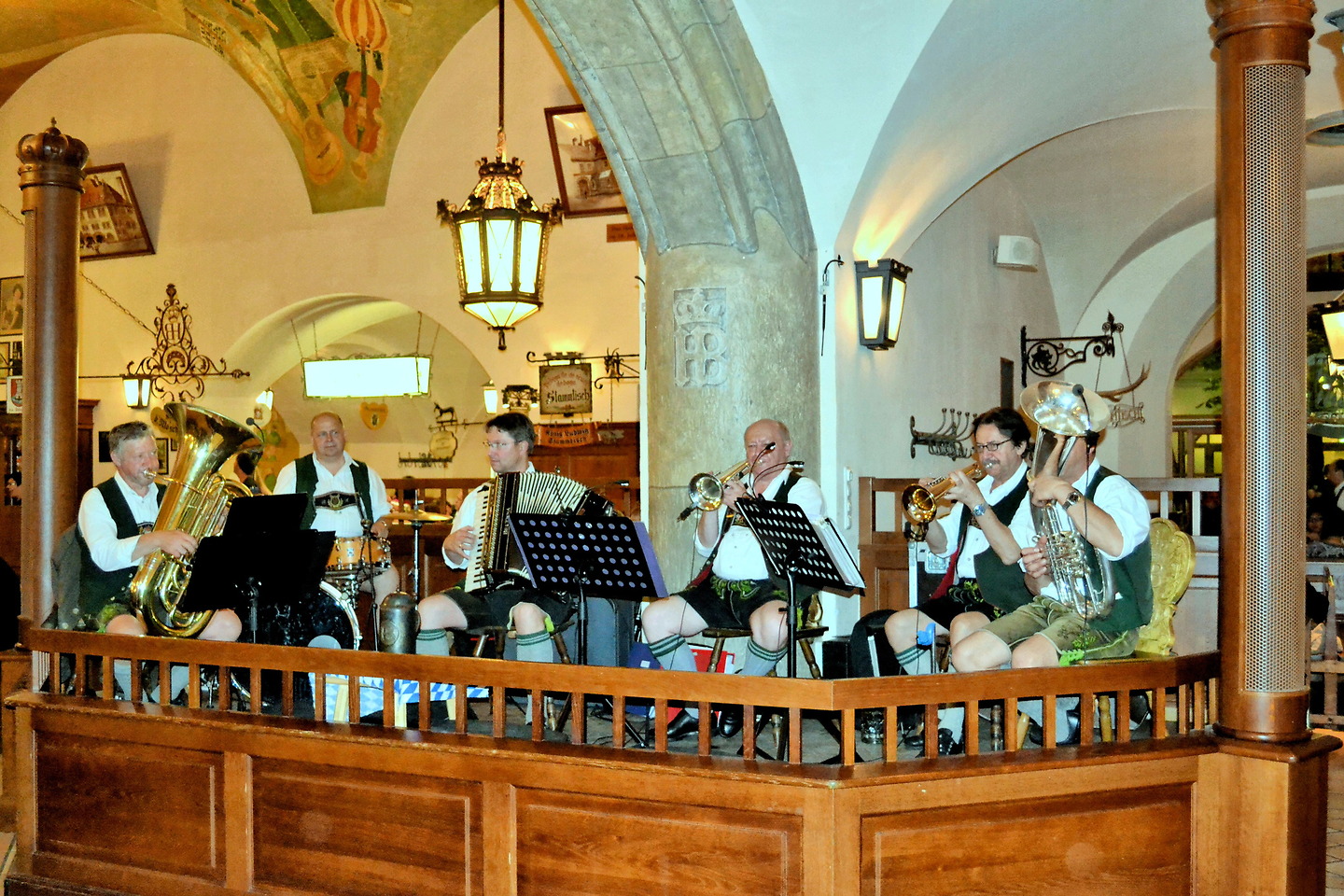
Oompah.
My great-grandparents on my mom’s side were from Germany. My grandfather played the concertina (like an accordion) in local dance bands & for fun. From the recordings I heard when I was a kid he was a master of the tradition.
My mom grew up in a small town in southeastern Illinois near St. Louis - the area was very German. I grew up in Minnesota, home to one of the largest German immigrant populations in the USA. My school district (along with many others around where I lived) offered German language instruction as part of the curriculum in elementary school. Pennsylvania, Ohio, Wisconsin, Illinois, Missouri (pretty much the entire upper Midwest) & Texas (accounting for the prominence of the accordion in Tex-Mex music) were all stocked with Germans.
Squeezing the Truth Link to heading
But, this is not really about accordions. It’s about an ACCESSORY for accordions.
How could there possibly be an ACCESSORY for an ACCORDION?!?!
In the early 1960s it probably didn’t make much sense either, but in the context of the explanation above it hopefully makes a little more sense than it would if the concept was introduced on its own.
For Italian companies producing fancy, high-end, deluxe accordions in the late 1950s like Farfisa (the actual maker of the Cordovox accordion, & yes, Italy 🇮🇹 loves accordions too…) maybe accordion accessories seemed normal. Travel “back to the future” with me… Imagine the following spoken in an Italian accent maybe?
Can you imagine a time when accordion music won’t be popular? Also, of course, the accordionist will want to trigger “modern” electronic sounds from their 25-pound instrument!
Of course they will want to carry around a giant deluxe accordion & a 60-pound cabinet full of vacuum tubes the size of a suitcase & another speaker cabinet that’s the same size & weight to amplify the whole thing (the accordion player should be as loud as the electric guitar player or the drummer, right?)
Also, the accordionist will be able to play their new electric organ sounds through a real rotating speaker cabinet.
Bella.
But, you might be saying, “Wait, what the hell is a rotating speaker cabinet?”
Laying Pipes Link to heading
At the risk of extending an essay that isn’t about accordions, which so far is only about accordions, to make the proper “Connections”, more words must be spilled about:
- Organs
- Psychoacoustics
- Don Leslie & Laurens Hammond
1. Organs are ancient Link to heading
Organs are believed to be the first known keyboard instruments. Examples date back to the 3rd century BC.
There are a few ancient paradigms that resulted in the earliest musical instruments:
- hitting a thing:
- a hollow log
- a membrane stretched across something
- plucking a taut string, like:
- a harp or lyre
Probably just as old is the concept of making sound by blowing air:
- through a tube, like:
- a recorder or flute
- a metal or bone horn
- over something that causes vibrations, like:
- a reeded horn (clarinet-esque, oboe-esque)
- a box with reeds inside like a harmonica
Pipe organs as we know them today were created during the Middle Ages. Charlemagne had one in his chapel at Aachen in 812 AD. Some historians claim that pipe organs from the 15th century through the industrial revolution of the 18th century were some of the most if not the most complex human-made objects crafted prior to the modern industrial era.
Pipe organs are big. Some of them, ridiculously so, filling entire buildings with ranks of pipes & electro-mechanical wonders. They are, in their grandest form, stationary.
This entails a quest: for something with the musical versatility of an organ, but smaller. (As someone who has carried around musical equipment, I can attest.)
Just in case it’s not obvious, the accordion is a type of organ that attempts (& in some ways succeeds & in some ways fails) to complete this quest:
- The instrument is held in the hands or “worn” like a reverse backpack, strapped to the shoulders
- Vented bellows are compressed & expanded to fill an air chamber
- A large volume of sound can be produced by forcing the stored air across a set of tuned reeds which vibrate in response
- By selectively controlling which reeds vibrate using a system of buttons or piano-style keys, an accordionist can play Polkas (or Tangos).
2. Human Hearing Is Crazy Link to heading
Psychoacoustics is the term used to describe the study of how aural perception interacts with the physics of sound. I am not a psychoacoustics expert, but, I did take an Acoustics class in college. I have the textbook to prove it. How is this relevant?
One of the compelling aspects of pipe organ music is that in a place where an organ is installed (usually a church), you are physically surrounded by the sound of it.
Modern implementations of “surround sound” (e.g., Dolby THX / Atmos, multi-speaker home theater or recording studio systems, etc.) are ultimately derivations of the “OG” surround sound setup: a giant organ with ranks of giant pipes in a room that’s 80 feet high & built of stone & glass for long reverberations & sound reflections.
Human beings are remarkably perceptive to sound in space. One of many reasons for this is the shape of the ear. It’s a cup. It faces forward, the same direction as our vision. We perceive sound differently in front of us than from behind. For humans with the ability to hear normally, the physical shape & positioning of the ear along with the binaural hearing field enable a pinpoint sound location capability. A byproduct of this capability is known as the precedence effect (also referred to as the “Haas” effect after its discoverer.) The simplest explanation of the precedence effect is that not only can humans detect sound location with exquisite precision, but the brain allows humans to track minute differences in located sounds over time.
3. Trying To Make a Thing That Does a Thing But Actually Making a Different Thing Link to heading
Along with not understanding that organs as musical instruments go all the way back to ancient Greece, most people are unaware that the history of electronic music stretches back into the 19th century. By the time Laurens Hammond was experimenting with electronic music in the 1930s, instruments like the Ondes Martenot were already on the market & in use.
Hammond was an engineering prodigy. He created many designs & patents before his work on the organ that bears his name. His stroke of musical genius seems derived from his work on clocks: the tonewheel.
How a Hammond organ works.
Though hardly anyone thinks of the Hammond organ this way today, Laurens Hammond was on the quest laid out above:
- Pipe organs were big & stationary
- Not every church or place that WANTED an organ could afford one
- Even if they could, the space needed to house an organ was a real limitation
He fully intended to invent a suitable, “portable” substitute for the traditional pipe organ. But, there were issues:
- The sound of his instrument was brilliant but not quite a pipe organ replacement
- The mechanism delivered pure tones but also some electronic artifacts (most notably a clicking sound at the beginning of a note)
- The pipe organ emulation didn’t fully manifest due to psychoacoustics
The sound of early Hammond organs came from a single stationary speaker which could not reproduce the effect of being surrounded by ranks of organ pipes in a reverberant space.
- Don Leslie bought a Hammond organ. The story goes that he was “disappointed” by the sound. He also wanted the “surround sound” experience. But, Leslie had an idea that had not occurred to Hammond: using a physical mechanism to trigger the precedence effect without the need for multiple speakers. His solution (finally)?
Fun facts:
- Leslie met with Hammond to show him the rotary speaker design
- He hoped Hammond would like it & would sell Leslie speakers with Hammond organs
- Hammond hated it so much that he attempted to make the Hammond organ “Leslie”-proof
- Hammond was sued by the FTC in 1936 for false advertising
- The company was questioned about its claims of emulating the sound of the pipe organ
- Hammond later said that publicity from the suit actually led to more organ sales
The funniest & most interesting aspects of music history are always found among the unintended consequences.
Laurens Hammond definitely did not get his way regarding Don Leslie’s invention. For years, Hammond organs & Leslie cabinets have been synonymous. They are almost always paired (like peanut butter & jelly or bacon & eggs).
The Leslie effect has powered jazz, gospel & rock music well beyond the pipe organ emulation Don Leslie imagined. This is partly due to the fact that over-amplifying the speakers in a Leslie cabinet to the point of clipping distortion (something that neither Leslie nor Hammond would have condoned) happens to sound very good. It may also be partly due to microphone techniques used on Leslie cabinets in recording studios & on live stages. Precedence effect reflections easily discerned in 3D space are flattened in the 2D stereo field when a Leslie cabinet is “mic-ed”. This (to my ears) enhances the “tremolo” aspects of the sound & mutes the “vibrato” (i.e., subtle pitch modulations) making the effect more audibly striking.
Understanding a bit about the history of the Hammond + Leslie pairing at last takes us where we need to go…
The System Link to heading
The rotating drum mechanism in the Cordovox CL-10 was manufactured by Leslie as the “leslie TREMOLO UNIT 10LR-2S”, evident in the first thumbnail photo above. I assume “10LR-2S” is shorthand for “10-inch Leslie Rotor with 2 speeds”.
The fully assembled unit was rebranded by Chicago Musical Instruments (CMI) with the Cordovox name & the CL-10 model designation. It was marketed & sold as part of a Cordovox accordion system (also pictured above).
The centerpiece of the system was both a traditional deluxe Italian acoustic accordion (generally considered to be the best, most lovingly-crafted accordions in the world) & a sophisticated electronic keyboard instrument (for its time). For all practical purposes it was a synthesizer, albeit one restricted to preset sounds.
In the early 2000s, I decided I had to acquire the entire system, i.e., a Super V Cordovox accordion, the tone generator cabinet & the amp. I found the whole shebang at an antique store in Phoenix. What can I say? I went through an accordion phase in the late 90s.
However, even though the set I obtained was in excellent condition for its age, once I had to move it & I realized its limitations, I decided not to keep it. I actually returned it to the shop where I bought it, which made me feel a bit guilty. I did pay a restocking fee, so, hopefully it all worked out & it eventually went to a good home.
In a crazy twist of fate, the electronic organ sounds playable from the otherwise traditional accordion were the reason the optional Leslie cabinet was offered as part of the system. An actual Leslie speaker was, at the time, the only way to produce the true Leslie effect. The Hammond + Leslie pairing was becoming so popular & ubiquitous in music by the 1960s that having a way to approximate the sound made sense as a design choice in a professional-grade, premium, keyboard-centric music package.
The CL-10 is roughly 1/3 the weight & size of a Leslie 122 / 147 (top-of-the-line Leslie models with not 1, but 2 separate rotating mechanisms.) Though the sizes & weights of the Cordovox system components by today’s standards may seem ridiculous, by the standards of 1960, this was sleek, miniaturized Italian luxury at its finest.
Make It Go Woo Woo Link to heading
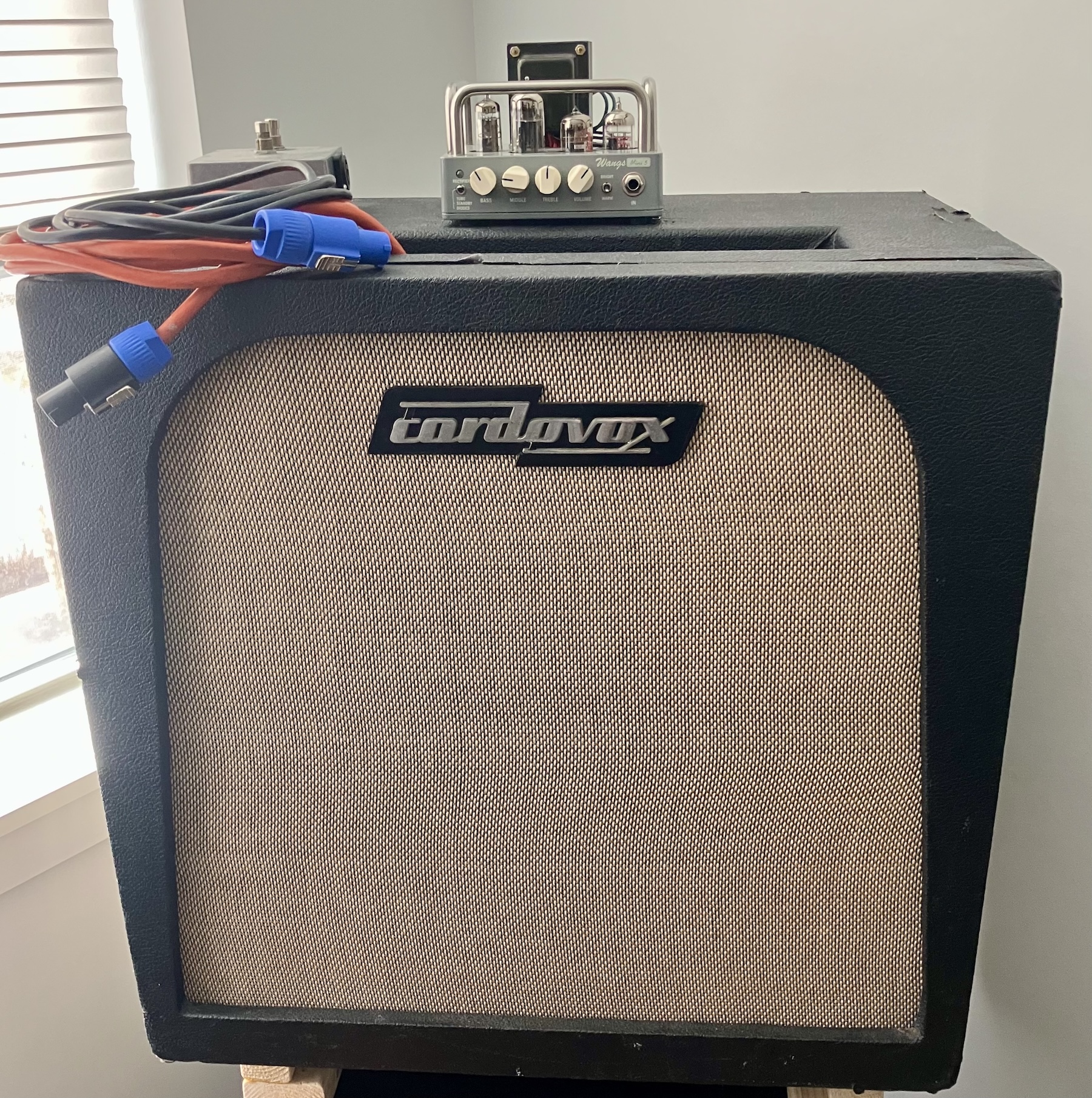
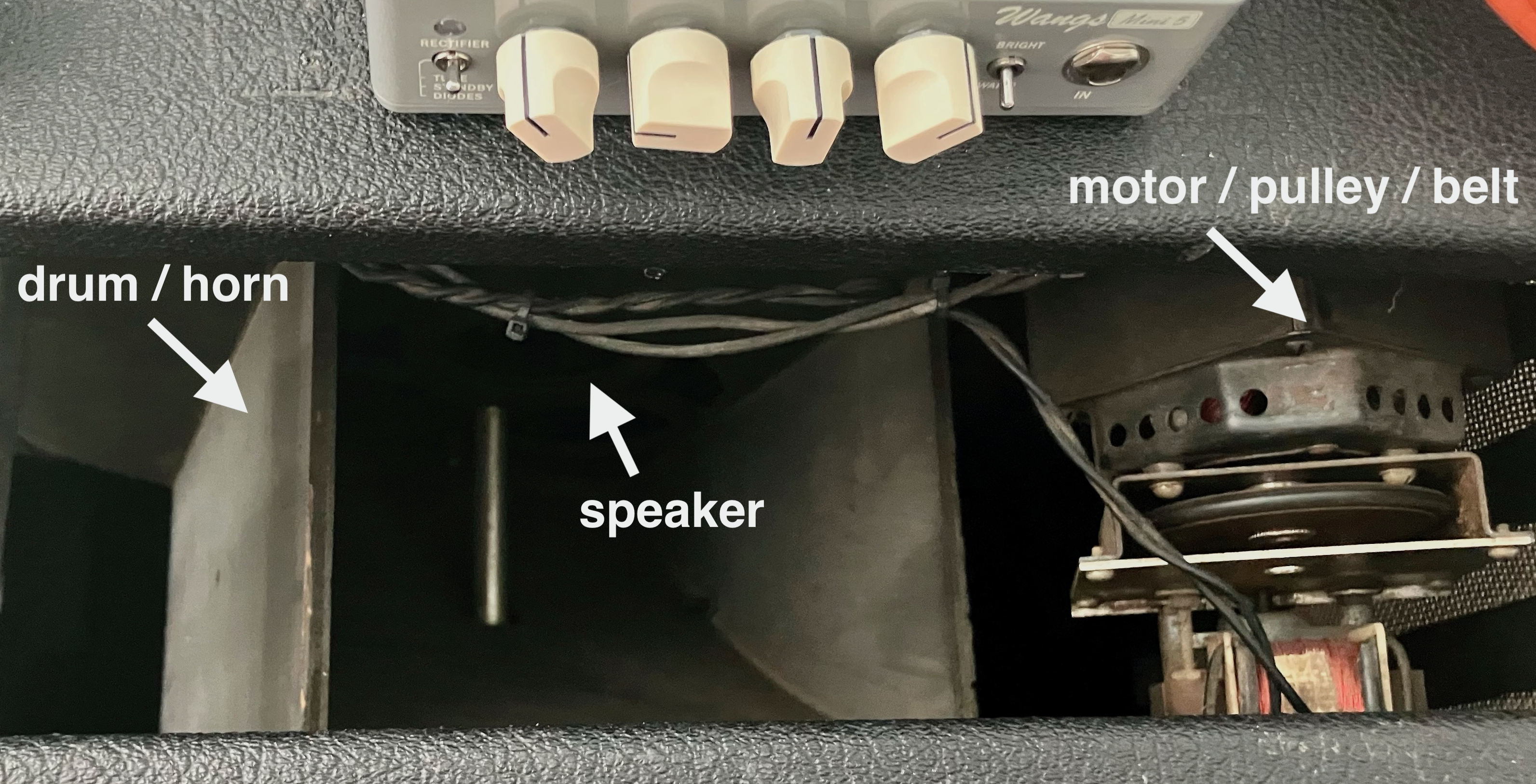
Externally, the Cordovox CL-10 is a passive speaker cabinet. Internally, it has a small speaker mounted vertically on a panel at the back & a wooden, mechanical rotating drum / horn mounted directly in front of the speaker.
The spin.
As far as I know this is the only photo of the Cordovox CL-10 rotary mechanism in the world. I can’t find another. The photo was taken through the top port of the cabinet from above. I intentionally removed the grill cloth from the top port so I could watch things spin around or stick a mic in there.
It’s a little difficult to see, but the drum is composed of 2 circular pieces of wood with an elegantly curved wedge shape sandwiched in between that forms the “horn”. The rotating drum / horn has 2 speeds:
- Slow (traditionally referred to as “Chorale”)
- Fast
By:
- plugging a signal into an amplifier
- plugging that amplified output into the Cordovox CL-10 speaker input
- turning on the rotating drum
- switching between the slow & fast speeds
you can make sounds running through the speaker go “woo woo”.
More accurately, the rotating drum / horn in front of the speaker randomly reflects sound in many directions perpendicular to the sound coming directly from the speaker itself.
The precedence effect tricks the brain via psychoacoustic interaction with the physical space around the speaker into detecting the minute differences in pitch & volume from the reflections. The result is a “surround sound” simulation.
Due to the complexity of the psychoacoustic phenomenon, reproducing the true Leslie effect has proven itself to be a modelling challenge. Many analog & digital emulations exist:
- early, decent-sounding units like the Dynacord CLS-222
- modern DSP hardware units like the Neo Instruments Ventilator series
- numerous, highly sophisticated, dedicated computer plugins
Most electronic keyboards sold today by major manufacturers like Yamaha, Roland, Korg & Clavia (Nord) have decent Leslie emulation effects, but even the best, most expensive options (to me) tend to get very close to the sound without re-creating the experience.
As my sister usually asks when I try to explain these things to her:
Why would anyone WANT to make the sound go “woo woo”?
All I can say is: listen to any of the 1000’s of recordings with Hammond organs screaming through Leslie cabinets to find out why. (There are some fine examples below.)
Story Link to heading
I bought my Cordovox CL-10 at Torps Music in St. Paul for 50 1987-era American dollars. I literally dug it out of their basement. It was dark down there. I couldn’t really determine the condition. Of course, when I was 16 I also had no chance of knowing what it really was either.
What I did know:
- I had a Yamaha YC-30 organ
- I had been simulating Leslie sounds with a cheap Electra Chorus pedal
- I modified the chorus pedal so that the rate knob was on the side
- That allowed me to adjust fast & slow with my foot
- The Torps guy said he had a little Leslie cabinet he would sell for $50
According to the Cordovox history above, the CL-10 was released in 1960-61. I don’t know the exact year my unit was manufactured. A newer model (the CL-20) became available in 1967-68. What I can say for sure is that from the styling, the hardware, the build, the printed materials & labeling on my unit, I could tell that s#!% was really old when I bought it.
For some reason I already had a cheap, low-wattage solid-state guitar amp I was mangling at home. I had disconnected it from the combo cabinet it came in. (I was doing a lot of this kind of thing back then.) It was exactly what I needed to power the CL-10.
Between getting the YC-30 (also for $50 at the long-gone Park Music in St. Louis Park, MN where my brother took trumpet lessons & I took my first saxophone lessons), having the amp head & finding the CL-10 without really looking, it felt very serendipitous. It felt like the universe was revealing itself to me or like the solution to a puzzle became clear. Digging a Cordovox CL-10 out of the Torps Music basement is as close as I’ll ever get to being Indiana Jones.
I very excitedly plugged it in as soon as I got home. The power switch housing (which was broken & showing fully exposed circuits & wires) sparked. Some of the cable insulation caught on fire. Electrical fires smell pretty bad.
So, it was usable. It was not really safe. Also, the house I grew up in was built in the 60s. Some of the electrical in the basement was pretty sketchy. A “match” made in heaven.
For years I left the unit in storage at my parent’s house. At some point I decided to have it shipped to Scottsdale as part of my studio build. It needed repairs. There weren’t that many places in the Phoenix area that did repairs & only one I trusted that would entertain modding & customization.
My friend Matt @ Field Services came up with all of these amazing improvements on his own for which I am very grateful. He:
- detached the flammable hard-wired power cable & switch box.
- separated the power connection from the switching (which was in-line on a single combined cable).
- made an over-engineered (the best kind of engineering) 2-button on / off + fast / slow switch box.
- used detachable Neutrik speakON™ connectors for the switch box & the power socket on the cabinet.
- made a new heavy-duty switch box cable.
- made a new heavy-duty power cable.
- fixed the cabinet’s goofy back door in place (it was no longer needed).
- probably did something to prevent the electric motor from catching on fire.
- cleaned it up inside & out.
- added fresh new grill cloth to all the ports.
In the photo at the top you can see the cables & the switch box.
It works!
It also, for a small speaker, sounds amazing in tandem with my Yamaha YC-45D.
I now power the Cordovox CL-10 speaker with a Wangs Mini 5 (heh) tube amp. It’s perfect. It’s sitting on top of the CL-10 in the first photo. I have the input of the Mini 5 routed to a patch bay so I can make any signal in the studio go “woo woo” if I want.
The transformer in the Mini 5, coincidentally, caught on fire about 6 months ago (most likely my fault for leaving it on without plugging it in to the speaker). It was repaired by the eccentric local tube amp repairman. (I thank God there always is one.) I think it’s accurate to say, based on their firey history, the Mini 5 & the CL-10 are the most dangerous pieces of gear I own so it’s fitting that I use them together.
What does it sound like? Link to heading
Excitement.
Who played it? Link to heading
Everybody.
What songs use it? Link to heading
So glad you made it.
Yes!
Oh mama.
Rollin'.
Take this message to my brother.